Hidden Stories

November 27, 2010

She arrived yesterday in a nondescript, brown cardboard box, 30 x 16 inches, following an overnight trip from Colorado. I was tracking her on my iPod and called my neighbors after I saw her confirmed delivery, only to find they had already retrieved her and placed her on the bench on the landing by our back door.

“Do you think it’s too cold there?”, my neighbor asked. “If so, I’ll be happy to put it inside for you.” I said that I’d appreciate such and asked if he could check on the kitty while upstairs. He agreed to both.

When we finally arrived home, around 9:30 in the evening, after the car was unloaded, the dog walked, the Thanksgiving leftovers put in the refrigerator, I changed clothes and asked if anyone wanted to join me in unwrapping the package.

“I’ve been waiting for you to do so,” replied my spouse from the other room.

With an X-acto knife and pair of scissors, I carefully worked through the layers of packing tape, cardboard, bubble wrap, more tape and a towel wrapped carefully, but tightly, around her. Finally unbound, I pulled her from the towel and at last saw the mandolin I’d coveted since I’d bought my first Martin Backpacker mandolin in 2002, when I first decided to take up this little instrument that intrigued me so. A intro-level Epiphone followed the Martin, then it was traded a year later for a nice, middle-of-the-road Eastman A model.
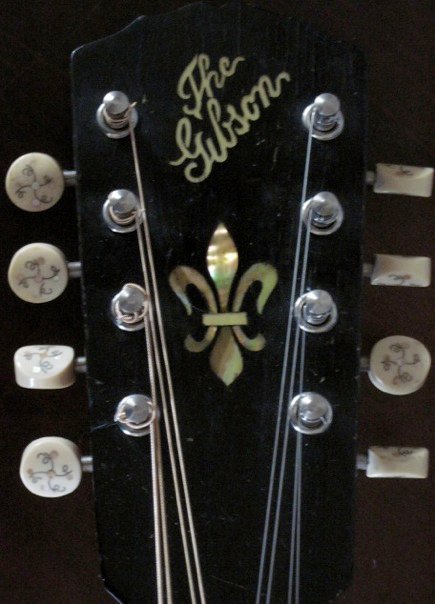
1914 Gibson A4 Mandolin

But it was a Gibson that I’ve longed for, specifically a pre-1930 A-4 with a black top. It’s the mandolin designed by Orville Gibson early in the last century that marked the real emergence of the instrument in the US. It’s not the classic Lloyd Loar F-5 that would follow, that by choosing it, Bill Monroe would make THE bluegrass mandolin (and of which only about 175 originals were ever made), but “the 1905 Gibson A-4 was a revolutionary instrument in its time, breaking radically away from the traditional bowl-back instruments brought to America by Italian immigrants (disparagingly referred to as ‘taterbugs’)… Though this design was subtly modified over the years, it clearly set the standard for what was to become the preferred style of mandolin used in American folk and popular music.” A Brief History of the Mandolin

When I found one on ebay last week, I hesitated for about an hour, then made an offer I couldn’t afford, but couldn’t afford not to make, either. The buyer accepted, promising that the instrument was in excellent condition after sitting in its case in a closet for the past 30+ years. When I pulled it from its mummy-like wrapping, I saw he had been completely truthful. There isn’t a scratch on her and though she’s a bit sleepy from not being played in so long, I can already hear the soft, rich, mellow voice that will in time emerge.

As I sit with her today I can’t help but wonder who has played her over the years. I wonder where she’s been. I wonder what kind of music she has made. I think there are stories to be told by her or perhaps to be made up from my imagination and attached to her. But regardless, we will tell some stories together. And I’m glad she found her way home to me.


And She Will Still Be Gone

November 11, 2010

“There is a gap,” I say, “A gap between what I believe my mom left behind and what I believe I add to the world.”

I’m trying to explain to my therapist the core of the sense of dissatisfaction I always feel with myself. We have been through the story many times in the past year. She knows it.

“She left the world a better place. She left the campsite cleaner than when she found it.”

“She left a mess.” A professional injection of reality. What I pay for.

“But the magnitude of the mess is a measure of that gap. The gap is all of the ‘extra’. Everyone has a mother and they run along a plane, you know. They all start here.”

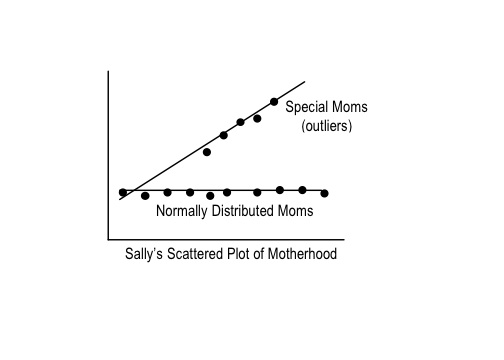
I make a motion with my hand, drawing a straight, horizontal line in the air like an x-axis. I also can’t help but think at the same time that she herself is a mother. I wonder where she falls on my graph of motherhood.

“But then some rise higher.”

I draw a line rising upward on my imaginary probability plot. I talk with my hands a lot.

“My mom was up here.” I make a plateau. “And it’s this space between here (left hand) and here (right hand above it) that I feel like I’m always measuring myself by.”

“And what makes that space?” she asks.

“The stuff. All the stuff that made her special. The stuff that made her absence so pronounced to everyone.”

I don’t say it out loud, but it’s implied. Who would miss me like that? Who would miss me this long? I can think of no one, a fact that I know is grossly unfair to my partner and to my friends. But it is there, all the same.

“What is the big difference between you and your mother?”

She cared about people. I care about people.
She had work that helped people. I work to help people.
People liked her. People like me.
She had friends. I have friends.
She had children.
I do not.

I kind of refuse to believe this last point has that much value to it, but…

“And so where is the gap?”

“I don’t know. Intellectually, I don’t know. But it’s right there!” More pointing at imaginary things.

“You can do everything to fill that gap, to measure up to something you’ve decided about your mother.”

Pause.

“Or you can choose to measure yourself against yourself.”

Pause.

“And you can decide to believe, based upon what you know of her, whether or not she is proud of you. Because you do know.”

Pause.

“But… she will still be gone. She will always still be gone.”

Longer pause. And I can feel her looking at me, though I’m staring at my shoe. It’s a look of care and concern. It’s the look that says, “Yes, this is my job, but I do really care about you.”

“She will still be gone.”

My mom has been gone for more than 25 years, but it’s like I hear this for the first time. In this particular moment, I hear it in a way unheard before. I feel it in a way I don’t remember feeling before.

She has made her point. Experiences are different each time we experience them. There are things that we will revisit again and again, and they’ll be different each time. One doesn’t replace the other, but adds to it. She describes them as layers, not to be peeled away, but to give depth.

I sit with the tears falling. I pull a tissue from the box on the table. I say that I need to go, that I’m expected at a meeting.

We sit for a few seconds more.

I hand her my check. We say we’ll see each other next week. I drive to work, to the meeting, to the rest of my day.

And she is still gone.


An Extra Hour of Memoir-ies

November 7, 2010

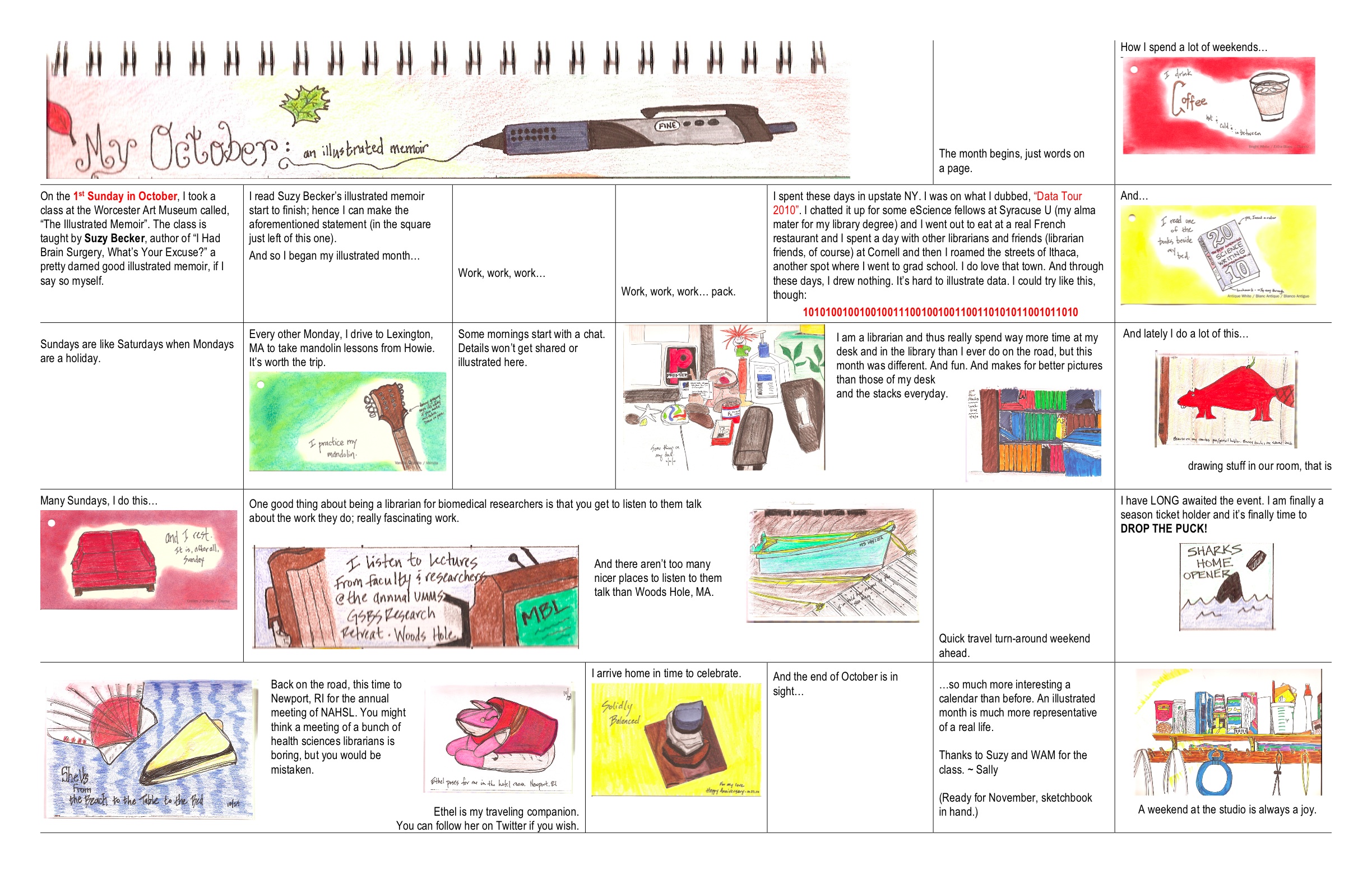
I put the finishing touches (well, the finishing touches until I print it and see what needs fixing) on my “October”, an illustrated memoir I worked on last month after taking Suzy Becker’s class on the subject at the Worcester Art Museum. It is not the project that I left the class hoping to start (as my self-addressed, self-written reminder postcard from the class reminded me when it arrived this week), but it’s a start that I’m happy with. I’ll get up to speed on the other project soon enough.

Lynn wants me to enter it into the adult student show that the WAM holds after each term of classes wraps up. We’ll see how it turns out. If it’s worth the expense of an inexpensive frame, maybe I’ll submit it.

Thanks to Suzy and to WAM for the class. It was a great Sunday – and continued to be a great month.