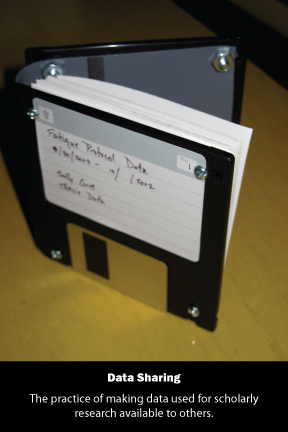
I made notepads out of old discs and paper for holiday presents this year. It’s nice to share.
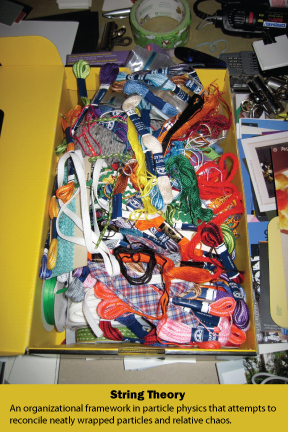
How else can you explain it?
I made notepads out of old discs and paper for holiday presents this year. It’s nice to share.
How else can you explain it?
 Leave a Comment » |
  daily muse | Tagged: crafts, data, presents, recycle, science |
  Permalink
 Posted by salgore

A very dear friend of mine was in town over the Thanksgiving holiday and we had the chance to visit with each other for a few hours. Between cheers for the hometown hockey team, we chatted about this, that and the other thing, though most of it revolved around me and my health. I’d had surgery a couple of weeks earlier and so, perhaps naturally, this was the topic most visited. My friend, though, has had a really difficult few years, filled with changes and stress. When our visit was over, after I waved goodbye from the curb and went back inside my home, I realized all of the things we didn’t talk about. I realized how, for all of our closeness and friendship, we hadn’t talked much at all about anything that was going on for her. I felt badly. I sent an email to share this; to tell my friend that I was aware this had occurred. She wrote back to tell me, “It was ever so much better to talk about you.”
This morning I received an email from another good friend, one who I’m scheduled to meet after work to do an exchange of some items. Her email was one sent to a number of friends, telling them that her mom had died somewhat unexpectedly the night before. There had been a long illness and hospice was involved, but still it came as a surprise. My friend then forwarded this email to me with an additional note that said, “I think I’ll still meet you… probably easier than figuring out what I should really be doing.”
When I was in seminary, my peace group dubbed me “The Prophetess of Doom.” Naysaying, I guess, was the gift I brought to our collective. I cannot deny that it fit me, but I’ve spent a lot of time and effort over the years since to shed myself of it. It’s not the character trait I’m most proud of. Thinking of my two friends and the recent experiences, I wonder if my real gift isn’t that of diversion. If you need to forget about what you should be doing, if you need a break from the realities of whatever is happening for you, if you need a detour from your life, you can call me and I’ll help you to think about and/or do something else. And as I think about that gift, I think it’s one I’m much happier to share, for friend who can give you a respite, is a good friend indeed.
Leave a Comment » | daily muse | Tagged: character trait, two friends | Permalink
Posted by salgore
[My “Presidential Piece” for the next MAHSLIN newsletter, posted here too because not all 7 fans of my writing are members of MAHSLIN.]
As we enter into December and the end of another calendar year, I can’t help but notice all of the “Best of…” lists that come out. There are the usual suspects; best movies, best books, best bands, and best CDs. We also celebrate the person of the year, the sportsperson of the year, the newsmaker of the year, and more. There’s always a great deal of discussion around these lists and no one ever comes up with any “top ten” that everyone can possibly agree upon. To address this conundrum and avoid any ugly altercations over what constitutes “best”, I decided to create a different kind of “Best of” list – the made-up kind. Thus, I present for you now, the 10 Best Books of 2011 that No One Wrote:
The library of a small college town in Wisconsin sees its fate play out with the arrival of a new librarian, supremely gifted in the art of getting to the heart of any patron’s question with charm, grace and, to the consternation of his colleagues, great speed. Harbinger brings to life a story of talent, ambition, and the human passion for greatness that can bring strife and envy to even the most tranquil of settings.
Towering compact shelving, rows of study carrels, haunting spirits and dead poets all come into play as a young girl tries desperately to cope with the grief of losing her family to electronic media. Rustling gives us a page-turner in this, her first novel. You will not soon forget the wisdom and bravery of her young heroine.
Cancathem, a 2002 Nobel Prize Winner for his work in economics, gives a sharply worded rebuke of those who would claim that life in the fast lane will kill you. We underestimate the value of all the things we cannot possibly remember. “The flood of irrelevant information will drown you, only if you resist,” he harkens.
Covering several centuries, the graphic novel Lexiconmix was inspired by the epic story of Google’s mission “to organize the world’s information and make it universally accessible and useful.” Beginning with their introduction of a nonsensical word to everyday language, the story unfolds as the two idealistic mathematicians give all of themselves to their quest, resulting ultimately in great personal wealth, but alas, insanity.
With a nod to science fiction, Perogies takes the Biblical story of the Rapture and turns it into quite the joy ride as doctors, nurses, students, and every working party known suddenly vanishes from a hospital, leaving the library staff to care for the patients left behind with them. Part fantasy, part humor, part inspiration, “Leftovers” shows just how far people really can go to help one another.
Noted poet, critic and scholar at the Library of Alexandria, Callimachus is credited with producing the first bibliographic survey of a library collection. His work, while held as a magnificent contribution to the field of information management, was also influenced by the fact that he was continually passed over when it came to the appointment of the Chief Librarian. His resentments seep through in the cataloging, most notably in his critique of Homer, whom he frequently called a “one hit wonderboy”.
A scholar argues that the translation and meaning of words need not be the same, nor even in the same realm, thus explaining, in a most amusing way, why very little at work makes sense some days.
Just what side DID the Hospital CEO come down on when it came to choosing between the medical library and information services? Formal gives us a work filled with characters you love one moment and despise the next. Her vivid descriptions of hospital administration and politics are gripping, and her examination of where and how the money goes is spellbinding.
A farcical romp; a library turned upside down when the small kitten adopted as the new “library kitty” turns out to be a bit more than expected.
Bezeebee topples the doubts of the deepest skeptic as he describes the story of the little catalog that could. From its humble roots as a bookmobile in Ohio, to its world dominance of integrated library systems, “WorldCat” inspires the reader to keep searching for that ever elusive dream.
Thanks to friends and colleagues who suggested their favorite books of the past year, the NY Times’ “100 Notable Books of 2011,” and a December deadline for the inspiration for this piece. Any resemblance to any actual title and author is… obvious. And, of course, meant in good fun.
Happy Holidays and all the Best in 2012!
2 Comments | daily muse, libraries | Permalink
Posted by salgore
You are currently browsing the blahg, blahg, blahg... blog archives for December, 2011.
 Recently Added to my LibraryThing Bookshelf Book Reviews from my Librarything Bookshelf
 blahg, blahg, blahg...
You must be logged in to post a comment.